Thursday, August 9, 2012

SAINT RAHIM

                                                            R   A   H   I   M


Mirza Abdul Rahim Khan-i-Khana was the son of Akbar’s trusted caretaker, Bairam Khan who had Turk ancestry. His mother was the daughter of Jamal Khan of Mewat. Abdul Rahim was born in Lahore.

After Bairam Khan was murdered, his wife became the second wife of Akbar, which made Abdul Rahim Khan-e-Khan his stepson, and later he became one of his nine prominent ministers, the Navaratnas, or nine gems.

Although a Muslim by birth, Rahim was a devotee of Lord Krishna and wrote poetry dedicated to him. He was also an avid Astrolger, and the writer if two important works in Astrology Khet Kautukam and Dwawishd Yogavali are still popular.

He is well known for his strange manner of giving alms to the poor. He never looked at the person he was giving alms to, keeping his gaze downwards in all humility. When Tulsidas heard about Rahim's strange method of giving alms, he promptly wrote a couplet and sent it to Rahim:

Aisi deni den jyu, kit seekhe ho sainjyon jyon kar oonchyo karo, tyon tyon niche nain
"Sir, Why give gifts like this? Where'd you learn that?Your hands are as high as your eyes are low"

Realizing that Tulsidas was well 'Aware' of the 'Truth' behind creation, and was merely giving him an opportunity to say a few lines in reply, he wrote to Tulsidas in all humility:

Denhar koi aur hai, bhejat jo din rainLog bharam hum par kare, taaso niche nain
"The Giver is someone else, bestowing, day and night.The world gives me credit: so, down are my eyes."

His two sons were killed by Akbar's son Jehangir and their bodies left to rot at the Khooni Darwaza because Rahim was not in favour of Jehangir's accession to the throne at Akbar's death.

His tomb is situated ahead of Humayun's Tomb in New Delhi. Later, in 1753-4, marble and sandstone from this tomb was used for the making of Safdarjung's Tomb, also in New Delhi.


***************************************************************************

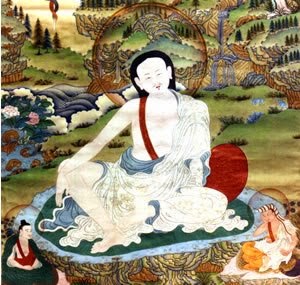
MILAREPA, THE GREAT YOGI of TIBET

According to a blessing Milarepa uttered towards the end of his life, anyone who but hears the name Milarepa even once attracts an instant blessing and will not take rebirth in a lower state of existence during seven consecutive lifetimes. This was prophesied by Saints and Buddhas of the past even before his lifetime.
                                                 M I L A R E P A,   Y O G I  of  T I B E T 
                                                                     M I L A R E P A 
                                              M I L A R E P A  Manifesting  Occult  Powers
                                             M A R P A ,  G U R U of  M I L A R E P A 
                                                   N A R O P A , G U R U  of  M A R P A
                                                   N A R O P A , G U R U  of  M A R P A 
                                                    T I L O P A ,  G U R U  of  N A R O P A


Milarepa

By

Sri Swami Sivananda

Tibet's Great Yogi: It was in the first autumn month, on the twenty-fifth day of A.D. 1052 under the influence of an auspicious star that Milarepa was born. His father gave him the name Thopaga (which means "delightful to hear"). He had one sister by name Peta. Milarepa's father was Mila-Sherab-Gyaltsen. Milarepa was born in a rich family. His hair was plaited with gold and turquoises when he was young. When Milarepa reached the age of seven, his father died. His uncle was in charge of the estate of Milarepa. He deceived Milarepa and his mother and ill-treated them. Milarepa was a black-magician in the beginning. He destroyed his enemies by launching a hailstorm just to please his mother. Then he repented very much and turned to the "white path" or the path of virtue.

Marapa was the Guru of Milarepa. Milarepa was also known by the name of Jetsun. Marapa tested Jetsun very much in various ways.

With great difficulty Milarepa got the highest initiation from his Guru, and became his pet disciple. He practised severe austerities and meditation in solitary caves. Demema, the wife of Marapa, treated Milarepa with kindness and tender affection, because Milarepa was energetic, sincere, hardworking and intelligent. He was shut up in a cave. Food was passed inside by the servant of Marapa through a small aperture in the side. Milarepa used to sit in a rigid posture with a lighted-lamp on his head, without moving till the light was out, were it night or day.

Milarepa meditated in various caves. His body was reduced to a skeleton owing to severe austerities. He lived on nettles only for several months. He followed the instructions of his Guru to the very letter. He developed various Siddhis. Just as Lord Krishna multiplied himself and appeared in the house of all the Gopis, so also Milarepa had the power to take as many forms as he liked. He played with his disciples by multiplying himself.

Milarepa once transferred his pain to the door of his meditation room. The door began to emit sounds of cracking and splitting. It throbbed and vibrated and was on the point of crumbling down.
Milarepa attained the state of Buddha-hood. The caves where he practised devotion and meditation are even now places of pilgrimage and worship. He had a large number of followers. Even now there are people in Tibet who belong to his school. He died in A.D. 1135 at the age of eighty-four. Those who desire to have a detailed study of his life can get a copy of the book "Tibet's Great Yogi—Milarepa" (by W.Y. Evans Wentz, Jesus College Oxford) from the Oxford University Press, London.

Source : http://www.dlshq.org/saints/milarepa.htm

MILAREPA


MARPA

Sekhar Gutog Monastery, Tibet
*******************************************************************************************


Tuesday, August 7, 2012

SRIMANTH SHANKAR DEV

                             
                                       SRIMANTH     SHANKAR      DEV
                                                    Born : 1449
                                                              Passed : 1568 ( 120 Yrs.)


Shankar Dev, who was born in Assam in 1449, was one of the greatest saints of India. But for the "Ekasharana Dharma," the Vaishnava movement initiated by him in Assam, the several tribal communities of that region would never have been drawn into the mainstream of Hindu society. Along with the doctrine of Bhakti, he brought hope to the hearts of the Kacharis, Miris, Garos and Mikirs. In the nam-ghars or houses of worship that he established, all were equal and all had access to God. Today almost every village in Assam has a nam-ghar. Besides being the venue of regular nam-karitan and festivals, the nam-ghar is the centre of all public activities. This has given rise to a type of rural panchayat which has remained a powerful religious and social institution to this day. Srimanta Sankaradeva was born into the Shiromani (chief) Baro-Bhuyans family, near Bordowa in Nagaon in a village called Ali-pukhuri in c1449. The Baro-Bhuyans were independent landlords in Assam, and belonged to the kayastha Hindu caste. His family-members, including parents Kusumvara and Satyasandhya Devi, were saktas. The Saint lost both his father and his mother at a very tender age and was raised by his grandmother Khersuti. He began attending the tol or chatrasaal (school) of the renowned scholar Mahendra Kandali at the age of 12 and soon wrote his first verses:


karatala kamala kamaladala nayana |


bhavadava dahana gahana vana sayana ||
napara napara para satarata gamaya |
sabhaya mabhaya bhaya mamahara satataya ||
kharatara varasara hatadasa vadana |
khagachara nagadhara fanadhara sayana ||
jagadagha mapahara bhavabhaya tarana |
parapada layakara kamalaja nayana ||

The complete poem was written before he was taught the vowels except, of course, the first one, and is often cited as an example of the early flowering of his poetic genius. He was physically very able, and according to legend, he could swim across the Brahmaputra while it was in spate. He left the tol in his late teens (c1469) to attend to his responsibilities as the Shiromani Bhuyan. He moved from Alipukhuri to Bordowa, and wrote his first work, Harishchandra upakhyan. Sankardeva produced a dance-drama called Cihna yatra, for which he painted the Sapta vaikuntha (seven heavens), guided the making of musical instruments and played the instruments himself. 

At Bordowa, he constructed a dharmagrha or a Hari-grha (house of the Lord) in which he installed an image of Vishnu that was found during the construction of the grha. But it was not meant for worshipping; it was just a "showpiece of art work". In fact, he was absolutely against any kind of worshipping of Idols or Images of gods. He married his first wife Suryavati when he was in his early 20s. His wife died soon after his daughter Manu was born.


Alipukhuri and Borduwa


It is possible the death of his wife increased his spiritual inclination as his mind began to focus, more than ever before, on the transcendental. When his daughter turned nine, he married her off to Hari, handed over the Shiromaniship to his grand uncles and left for a pilgrimage (c1482). At this point of time, he was 32. The pilgrimage took him to Puri, Mathura, Dwaraka, Vrindavan, Gaya, Rameswaram, Ayodhya, Sitakunda and almost all the other major seats of the Vaishnavite religion in India. At Badrikashrama, he composed his first bargeet-mana meri ram charanahi lagu-in Brajavali. He returned home to Ali-pukhuri after 12 years (his family had moved back from Bordowa in his absence). During his pilgrimage, he witnessed the Bhakti movement that was in full bloom in India at that time. 


After his return, he refused to take back the Shiromaniship. On his grandmother's insistence, he married Kalindi at the age of 44. Finally, he moved back to Bordowa and constructed his first naamghar (prayer hall), and began preaching. He wrote Bhakti pradipa and Rukmini harana. Soon after, he received a copy of the Bhagavata Purana from Jagadisa Misra of Tirhut which had in it commentaries from Sridhara Swami of Puri, an Advaita scholar, and began rendering it into Assamese. He also began composing the Kirtana ghosha. The 13 years at Ali-pukhuri was the period during which he reflected deeply on Vaishnavism and on the form that would best suit the spiritual and ethical needs of the people.


Dhuwahat

From Ali-pukhuri he moved again to Gajalasuti and then back to Bordowa. In the mean time the Bhuyans were getting weak politically and Bordowa was attacked by the neighboring tribes. Sankaradeva had to move again from place to place. At Gangmau he stayed for five years where his son Ramananda was born. While at Gangmau, the Koch king Viswa Singha attacked the Ahoms. The Bhuyans fought for the Ahoms and the Koch king was defeated. Due to the unsettled situation at Gangmau Sankaradeva next moved to Dhuwahat, present day Majuli, now an island on the Brahmaputra. 

At Dhuwahat, he met his spiritual successor Madhavadeva. Madhavdeva, a sakta, got into a religious altercation with his brother-in-law Ramadasa who had recently converted to Vaishnavism. Ramadasa took him to Sankaradeva, who, after a long debate, could finally convince him of the power and the efficacy of Naam Dharma. At Dhuwahat he initiated many others into his religion and continued composing the Kirtana ghoxa. He tried to appease the brahmans by gentle persuasion and debate, but they felt threatened by the emergence of a new religion propagated by a non-brahmin. Some brahmans submitted a complaint with the Ahom king Suhungmung, who summoned Sankaradeva and Madhavadeva to court. They gave adequate replies to the royal queries and were let off.

Though the relationship with the Ahom royalty began cordially, it soon deteriorated. Once on the charge of dereliction of duty, Hari, Sankaradeva's son-in-law, and Madhavadeva were arrested and sent to the capital Garhgaon, where Hari was executed. Madhavadeva's life was spared but he was imprisoned for a year. This incident pained Sankaradeva much and he, along with his family and Madhavadeva, journeyed toward the Koch kingdom. At Dhuwahat, he wrote the drama Patniprasada.

Patbausi

At Sunpora he initiated Bhavananda, a rich trader who had extensive business interest in the Garo and Bhutan hills besides Kamarupa. The trader, Narayana Das, settled at Janiya near Barpeta and took to agriculture. A man of the world otherwise, he soon flourished and became a provider to Sankaradeva and his devotees. He came to be known popularly as Thakur Ata. 

After a great deal of moving, Sankaradeva settled at Patbausi near Barpeta and constructed a Kirtanghar (house of prayer). Some of the people he initiated here are Chakrapani Dwija and Sarvabhauma Bhattacharya, brahmins; Ketai Khan, a kayastha; Govinda, a Garo; Jayarama, a Bhutia; Murari, a Koch and Chandsai a Muslim. He also befriended Ananta kandali, a profound scholar of Sanskrit, who translated parts of the Bhagavata Purana. Damodardeva, another brahmin, was initiated by Sankaradeva and he later became the founder of the Brahma Sanghati sect of Sankaradeva's religion.

Among his literary works, he completed his rendering of the Bhagavata Purana and wrote other independent works. He continued composing the Kirtana Ghosha, further translated the first book of the Ramayana (uttarakanda) and instructed Madhavadeva to translate the last book (adikanda), portions that were left undone by the 14th century poet Madhav Kandali. He wrote four dramas: Rukmini harana, Parijata harana, Keligopala and kalidamana. Another drama written at Patbausi, kamsa vadha, is lost. At Patbausi, he had lent his bargeets numbering aroung 240 to Kamala Gayan. But unfortunately, his house was gutted and most of the bargeets were lost. Since that incident Sankaradeva stopped composing bargeets. Of the 240, 34 remain today.

Sankaradeva once again left for a pilgrimage with a large party of 117 disciples that included Madhavadeva, Ramarama, Thakur Ata and others. Madhavadeva, on the request of Sankaradeva's wife Kalindi urged him to return from Puri and not proceed to Vrindavana. He returned to Patbausi within six months.

Kochbehar

On hearing complaints that Sankaradeva was corrupting the minds of the people by spreading a new religion, Naranarayana the Koch king, ordered Sankaradeva's arrest. Sankaradeva managed to go into hiding, but Narayan Das Thakur Ata and Gokulchand were captured. They were taken to Kochbehar and subjected to inhuman torture, but they did not divulge the location where their Guru was staying, and the royals soon gave up. In the meantime Chilarai, the general of the Koch army and brother of Naranarayana, who had been influenced by the religion and had married Kamalapriya, the daughter of Sankaradeva's cousin Ramaraya, arranged for Sankaradeva's audience with Naranarayana.

As he moved up the steps to the throne, Sankardev sang his Sanskrit totaka hymn (composed extempore) to God, and as he sat down, he sang a borgeet, narayana kahe bhakati karu tera. Naranarayana was overwhelmed by the Saint's personality. The king then asked Sankaradeva's opponents to prove their complaint. After Sankaradeva defeated them in the debate, Naranarayana declared him free from all allegations. Sankaradeva began attending Naranarayana's court at the king's request. When he met Naranarayana, he was well over a hundred years old and had just three more years to live. After the debate, Sankaradeva shuttled between Kochbehar and Patbausi. On the request of Nara Narayan and Chilarai he supervised the creations of the 60mx30m woven Vrindavani vastra, that depicted the playful activities of Krishna in Vrindavana. This was presented to the Koch king.

End

He made arrangements with Madhavadeva and Thakur Ata and gave them various instructions at Patbausi and left the place for the last time. He set up his home at Bheladonga in Kochbehar. During his stay at Kochbehar, Naranarayana expressed his wish to be initiated. Sankaradeva was reluctant to convert a king and declined to do so. According to one of the biographers (Ramcharan Thakur), a painful boil-a visha phohara - had appeared in some part of his body and this led to the passing away of the Saint. According to other accounts (Guru Charit Katha et al.), Naranarayan's adamance that he be initiated into the new religion led the saint to surrender his life to the Lord by way of meditative communion. Thus, in 1568, after leading a most eventful life dedicated to enlightening humanity; the Mahapurusha died - within six months of his stay at Bheladonga - at the remarkable age of 120 years.

Eka Sarana

Sankaradeva used the form of Krishna to preach devotion to a single God (eka sarana), who can be worshiped solely by uttering His various names (naam). In contrast to other bhakti forms, eka sarana follows the dasya attitude (a slave to God). Moreover, unlike the 'Gaudiya Vaishnavism' of Bengal, Radha is not worshiped along with Krishna. In uttering the name of God, Hari, Rama, Narayana and Krishna are most often used. 

Sankaradeva himself and the religion in general are particularly antagonistic to saktism which was strongly prevalent in Assam at the time. This probably explains the non-use of Radha as an icon. A non-brahmin, Srimanta Sankaradeva started a system of initiation (saran lowa) into his religion. He caused a huge Social revolution by fighting against anti-social elements like casteism prevailing at that time. He initiated people of all castes and religions, including Muslims. After initiation, the devotee is expected to adhere to the religious tenets of eka sarana. Failure to adhere to these tenets led to ex-communication in certain cases. Though he himself married twice, had children and led the life of a householder, his disciple Madhavadeva did not. Some of his followers today follow celibate monkhood (kevaliya bhakat) in the Vaishnavite monasteries - the sattras.

The people who practice his religion are called variously as Mahapurushia, Sarania or Sankari.

Works
Literary

Sankaradeva produced a large body of work. Though there were others before him who wrote in the language of the common man - Madhav Kandali who translated the Ramayana into Assamese in the 14th century - his was the first ramayana to be written in a modern Indian language. His language is lucid, his verses lilting, and he infused bhakti into everything he wrote. His magnum opus is his Kirtana-ghosha, a work so popular that even today it is found in nearly every household in Assam. It contains narrative verses glorifying Krishna meant for community singing. It is a bhakti kayva par excellence, written in a lively and simple language, it has "stories and songs for amusement [for children], it delights the young with true poetic beauty and elderly people find here religious instruction and wisdom". 

For most of his works, he used the Assamese language of the period so the lay person could read and understand them. But for dramatic effect in his songs and dramas he used Brajavali, an artificial mixture of Braj language and Assamese. Other literary works include the rendering of eight books of the Bhagavata Purana including the Adi Dasama (Book X), Harishchandra-upakhyana (his first work), Bhakti-pradip, the Nimi-navasiddha-samvada (conversation between King Nimi and the nine Siddhas), Bhakti-ratnakara (Sanskrit verses, mostly from the Bhagavata, compiled into a book), Anadi-patana (having as its theme the creation of the universe and allied cosmological matters), Gunamala and many plays like Rukmini haran, Patni prasad, Keli gopal, Kurukshetra yatra and Srirama vijaya. There was thus a flowering of great Bhakti literature during his long life of 120 years.

Poetic works

Kirtana-ghosha
Harischandra-upakhyana
Rukmini-harana
Ajamilopakhyana
Bali-chalana
Kurukshetra-yatra
Gopi-uddhava-samvada
Amrta-manthana
Krishna-prayana
Kamajaya
Bhakti Theory
Bhakati-pradipa
Anadi-patana
Nimi-navasiddha-samvada
Bhakti Ratnakara (in Sanskrit)
Gunamala
Drama (Ankia Nat)
Cihna Yatra (lost)
Patni-prasada
Kalia-damana
Keli-gopala
Rukmini-harana
Parijata-harana
Srirama-vijaya

Sankaradeva was the fountainhead of the Ankiya naat, a form of one-act play. In fact, his Cihna Yatra - staged by him when he was only 19 - is regarded as one of the first open-air theatrical performances in the world. Cihna yatra was probably a dance drama and no text of that show is available today. Innovations like the presence of a Sutradhara (narrator) on the stage, use of masks etc., were used later in the plays of other eminent playwrights. These cultural traditions still form an integral part of the heritage of the Assamese people.

Songs

Borgeet (composed 240, but only 34 exist now)
Bhatima 
- Deva bhatima - panegyrics to God
- Naat bhatima - for use in dramas
- Raja bhatima - panegyrics to kings (to king Nara Narayan)
The Borgeets (literally: great songs) are devotional songs, set to music and sung in various raga styles. These styles are slightly different from either the Hindustani or the Carnatic styles. The songs themselves are written in the 'Brajavali' language.

Dance

Sattriya dance, that Sankaradeva first conceived and developed and which was later preserved for centuries by the sattras, is now among the classical dance forms of India.

Source : http://www.sssbalvikas.org/glory4-mar10.htm

******************************************************************************

SAINT APPAR


                                                     S A I N T     A P P A R    
                                                          ( Belong to 7th century AD )
Thiru-navuk-arasar (Appar) then spent his days in worshipping and serving the Lord in various ways, to set an example even to saints that they should not relax their eternal spiritual vigilance, lest they should fall a prey to maya. Thiru-navuk-arasar (Appar) exhorted other saints to lead the ideal life of a humble devotee for the guidance of others. Thiru-navuk-arasar (Appar) also visited many sacred shrines, thus, emphasizing the glory of pilgrimage. 

The thought that Thiru-navuk-arasar (Appar) had lived for some time with the Jains, eating their food and mixing with them made Thiru-navuk-arasar (Appar) feel that his body was still impure, for the worship of Lord Siva. He prayed to Lord Siva, "I do not want to live any more in this impure body. Let me have the stamp of your Trident and Nandi on my body, and then I shall regard it as fit for Your worship." At once, a divine servant of Lord Siva approached Thiru-navuk-arasar (Appar) and put the stamp of the Trident and Nandi (one of the Saivite rituals of initiation, according to the Agamas) on Thiru-navuk-arasar (Appar)'s shoulders. He, thus, experienced supreme bliss immediately. 

Thiru-navuk-arasar (Appar) then went to Chidambaram. The very sight of the temple tower sent him into a trance. He sang thrilling hymns here and prayed, "Let me serve you. Your bhaktas know no want nor fear. Even Lord Yama cannot dare to approach them. I have come to your abode where no sin can approach. I have surrendered myself to You. I have enshrined your lotus feet in my heart." At Chidambaram, Thiru-navuk-arasar (Appar) heard of the glory of Thiru-jnana-sambanthar and how the child prodigy was blessed by Mother Parvathi. Thiru-navuk-arasar (Appar), therefore, was very eager to meet the great child saint who was at Shiyali. 

As Thiru-navuk-arasar (Appar) was proceeding towards Shiyali, Sambanthar also was happy and was eagerly looking forward to meeting Thiru-navuk-arasar (Appar). When Thiru-navuk-arasar (Appar) reached the outskirts of Shiyali, Sambanthar went forward to receive him. They fell at each other's feet, and set an example in saintly conduct. Thiru-navuk-arasar (Appar) and Sambanthar then went to the temple and worshipped the Lord. At Sambanthar's request, Thiru-navuk-arasar (Appar) sang a hymn here, "When the whole world was submerged during Pralaya, Lord Thoniappar (Siva) was seated with his consort in the boat of Pranava (OM) surrounded on all sides by Devas in the form of birds." Even now the temple of Lord Thoniappar is in the form of a boat. They who cling to His feet are protected. 

Along with Sambanthar, Thiru-navuk-arasar (Appar) visited the temple at Thirukkolaka. Thiru-navuk-arasar (Appar) then took leave of Sambanthar and left the latter's ashram and after visiting many shrines, reached Thiruvaavaduthurai. He sang a hymn here expressing intense vairagya, "Oh Lord, I am caught in the wheel of births and deaths. I am tired of this. Show me a way to get out of it."
Then he came to Sattimutham. He prayed to the Lord, "Oh Lord, place thy lotus feet on my head before I leave this body." 

The Lord said, "Come to Thirunallur. I will fulfill your wish." 

Thiru-navuk-arasar (Appar) accordingly went to Thirunallur and worshipped the Lord who placed His Feet on the head of Thiru-navuk-arasar (Appar). He then sang, "Oh Lord, thy holy feet are adored by men on earth and the gods in heaven. Even great tapaswins cannot touch your feet if their devotion to you is tainted. But they are easily accessible to the real devotees who serve with faith and devotion. The sacredness of your divine feet cannot be understood by ordinary men. They [your feet] are the bestowers of all prosperity and immortal bliss." 

At Thiruvaaroor, Thiru-navuk-arasar (Appar) was given a rousing welcome by the Siva bhaktas. He had the Lord's darshan there. His heart was overflowing with love. He shed tears of love. He danced in joy. He was immersed in divine bliss. He sang hymns expressing regret for his mistake in joining Jainism. He felt that he would have been blessed with the Lord's darshan earlier had he remained a Saivite and carried on with his worship of Siva with devotion. Thiru-navuk-arasar (Appar) also sang a hymn praising the sincere devotion and greatness of Nami-nandi Adigal - who lighted the lamp with water in this sacred shrine when he could not get oil anywhere. 

Then Thiru-navuk-arasar (Appar) went to Thirupukalur, after visiting other shrines on the way. Thiru-jnana-sambanthar was there, too, and the two saints met each other for the second time. At Appar's request, Sambanthar went to Thiruvaaroor and had the Lord's darshan there. The two saints then moved on to Thiruveelimalai. Famine raged there at that time. Thiru-navuk-arasar (Appar) and Sambanthar were greatly moved by the suffering of the people and prayed to the Lord for relief. The Lord promised to give them a golden coin each every day, with which they could feed the people. Lord Siva placed two coins, one at the western entrance and the other at the eastern entrance to the temple - both Thiru-navuk-arasar (Appar) and Sambanthar collected the coins and relieved the suffering of the people. The famine soon came to an end. Both the saints praised the glory of the Lord and left. 

Then they came to Thirumaraikadu or the present Vedranyam. Once upon a time, the Vedas themselves used to worship the Lord here. When people neglected the study of the Vedas, this was discontinued. From that time, the door by which the Vedas used to enter, remained closed. There was another door by which people would go in and worship. Appar and Sambanthar heard of this when they came there. Sambanthar desired to enter through the door which remained closed. He requested Appar to sing a song. The doors opened by themselves, by the Will of God. They went in and worshipped the Lord. When they returned to that entrance, Appar requested Sambanthar to sing a song, so that the door could close again. Sambanthar sang and the door closed again. 

During another pilgrimage, Thiru-navuk-arasar (Appar) felt the pangs of hunger as he was approaching Thirupainjeeli. Lord Siva wanted to appease Thiru-navuk-arasar (Appar)'s hunger and thirst, so Siva created a tank and a garden on the way, so that Thiru-navuk-arasar (Appar) could quench his thirst and rest in the garden. The Lord Himself waited there in the guise of a Brahmin, with food in hand and gave it to Thiru-navuk-arasar (Appar) as soon as he arrived. Appar took the food, drank the water and was resting when the Brahmin enquired where Thiru-navuk-arasar (Appar) was going. Thiru-navuk-arasar (Appar) said that he was going to Thirupainjeeli. They both started to walk. When they were near the place, the Brahmin suddenly disappeared, and Appar understood that it was none other than the Lord Himself. He wept bitterly for not recognizing Lord Siva earlier and rolled on the ground on account of his separation. 

After visiting Thiruvannamalai, Kancheepuram, and Kalahasthi, where he sang the glories of Kannappar, Appar felt a desire to go to Kailasa. He went to Banaras and worshipped Lord Viswanath. He turned northwards and crossed many thick forests infested by wild animals. By Thiru-navuk-arasar (Appar)'s mere look, the wild animals became tame! He walked night and day. His feet were sore. Then he crawled with his hands. His elbows began to bleed now. Then he used his chest and crawled on. His chest also began to bleed and the ribs began to break. Still, Appar, undaunted, continued his journey to Kailasa, rolling on the ground. Appar wanted to go to Kailasa but the Lord wanted that Thiru-navuk-arasar (Appar) should live in the world for many more years singing His glories. The Lord created a tank nearby and appeared before Appar in the form of a saint, with matted locks, rudraksham and holy ashes. The saint found out from Appar that he was proceeding to Kailasa and said, "Oh friend, the Lord of Kailasa cannot be seen by human beings. So, turn back." Appar said, "So long as I have this body, I will not turn back without going to Kailasa." He turned towards the saint again, bowed to him, and began to part for Kailasa. 

Appar understood it was the Lord Himself. The Lord afterwards kept Appar invisible company, giving him encouraging words now and then. Appar mentally prayed to the Lord, "Oh Lord, give me a fresh body, so that I may continue the journey." 

The Lord directed Thiru-navuk-arasar (Appar) to take bath in a near-by tank and said, "You will see me and my abode (Kailasa) in Thiruvayar." Appar, repeating the Panchakshari Mantra, took a dip in the tank. He came out of the tank, and found himself in the tank at Thiruvayar - hundreds of miles away to the south! Thiru-navuk-arasar (Appar) came outside and saw everywhere Siva and Sakthi. He entered the temple and saw Mount Kailasa there. He saw Lord Siva seated with Mother Parvathi, surrounded by gods, and celestial servants praising his glory. Thiru-navuk-arasar (Appar) went into a trance, sang Lord Siva's glories and danced. 

Then, Thiru-navuk-arasar (Appar) had a mutt built for him at Thirupoonthurai and remained there. Sambanthar had, in the meantime, defeated the Jains at Madurai and was coming to Thirupoondurai. Appar went forward to receive him. Without Sambanthar's knowledge, Appar quietly joined those who were carrying Sambanthar's palanquin. 

On reaching Thirupoonthurai, Sambanthar cried out, "Where is Appar?" and Appar, from below the palanquin coolly announced himself. At once Sambanthar jumped out of the palanquin and fell at the feet of Appar who had, by his example, demonstrated the humility of a true saint. They embraced each other and shed tears of love. Then, Thiru-navuk-arasar (Appar) wanted to see the state of Saivism in the Pandyan kingdom, for himself and left for Madurai. The king (Ninra-Seer-Nedumaar Nayanar), the queen (Mangaiyarkarasi Ammaiyar Nayanar), and the minister (Kulachirai Nayanar) welcomed Thiru-navuk-arasar (Appar) with devotion. Appar remained there for some days, worshipping the Lord. Then he went to Rameswaram and other sacred places before returning to Thirupukalur. 

Lord Siva wanted to test Thiru-navuk-arasar (Appar) at Thirupukalur. So when Appar was doing his services in the temple, the Lord made the entire floor appear as though it was strewn with gold and diamonds. To Appar, gold and diamonds were worthless as straw. So, he collected all of them and threw them in a near-by tank. Again, the Lord made celestial damsels appear before him and tempt him with their charms. Appar remained undisturbed. His entire heart and soul was centered on the lotus feet of the Lord. Having passed all the tests Lord Siva gave him, Appar spent the rest of his life there and at the age of 81 merged himself in Lord Siva.

SANTHA SURDAS

                                                           S A N T H A   S U R D A S 
                                                             Born : 1478  or 1479 AD
                                                          Passed : 1581 or 1584 AD

Surdas is one of the people who had great influence on the cultural heritage of India. He was a poet, a saint and a musician and played all the parts with the same finesse. Sin ce there are no authentic records on the life of Surdas, his biography comes up as a combination of facts and fiction.

Early Life

There is a little disagreement regarding the exact birth date of Surdas, some scholars believe it to be 1478 AD, while others believe it to be 1479 AD. Same is the case of the year of his death, it is either considered to be 1581 AD or 1584 AD. As per the limited authentic life history of Surdas, it is said that he lived in Braj, near Mathura. Surdas was born blind and because of this, he was neglected by his family. As a result, he left his home at tender age of six.

Meeting Shri Vallabharacharya

In the eighteenth year of his life, Surdas went to Gau Ghat, a sacred bathing spot on the embankments of Yamuna River. It was here that he came across Shri Vallabharacharya, the great saint-savant. Vallabharacharya advised Surdas to sing Bhagvat Lila, the Creative Play of the Lord and introduced him to the secrets of contemplative devotion. From this time onwards, Surdas never looked back on the path of spirituality. Surdas spent the last years of his life in Braj, the place of his birth.

Literary Works of Surdas

The work of Surdas mainly consists of the following three compilations.

Sur-Saravali
Sur-Saravali, based on the festival of Holi, originally consisted of hundred verses. In this poem, he tried to create a theory of Genesis, with Lord Krishna as the Creator.

Sahitya-Lahiri
Sahitya-Lahiri is mainly associated with Bhakti (devotion) towards the Supreme Lord.

Sur-Sagar
Sur-Sagar is considered to be the magnum opus of Surdas. The poem has been woven around the life of Lord Krishna. It originally contained 100,000 poems or songs, out of which only 8000 have survived the travails of time.

Philosophy of Surdas

The Bhakti movement that was widely prevalent in India at the time of Surdas deeply affected him. He propagated the Shuddhadvaita school of Vaishnavism. It makes use of the spiritual metaphor of the Radha-Krishna Lila, derived from earlier saints.

Source : http://www.iloveindia.com/spirituality/gurus/surdas.html

*******************************************************************************

Monday, August 6, 2012

SANTA EKNATH


                                                 S A N T A     E K N A T H
                                                                         Born : 1533 AD
                                                                      Passed : 1599 AD


By SWAMI SIVANANDA

Ekanath is a well-known saint of Maharashtra. He was born of Suryanarayana and Rukmini in the year 1533 A.D. at Paithan in Maharashtra. The fire of devotion was kindled in his heart even when he was a boy of ten years. This was all due to his previous Samskaras. The Gita says: "There he regains the understanding acquired in his former body and strives still further for perfection". (Ch. VI-43)

Once Ekanath heard an Akasa Vani, a voice from the sky, which said: "See Janardana Panth at Devagiri. He will put you in the proper spiritual path and guide you".

Ekanath immediately proceeded to Devagiri, met Janardana Panth and prostrated at his feet. Janardana accepted Ekanath as his disciple. Janardana was the Dewan of the province of Devagiri. Ekanath lived with his Guru for eight years and served him heart and soul.

One day Janardana asked Ekanath to find out a mistake of one pie in the account book. Ekanath sat the whole night to detect the error. He laboured very hard and at last found it out just before daybreak. Ekanath was extremely glad. He informed his Guru that he had found out the error. Janardana replied, "You had to concentrate so much to detect a small error in the accounts. Then how much more concentration will you need to find out God? You rejoice now when you have found out a small mistake in the account. How much happy would you be if you find out the mistakes in your life’s account?". Ekanath learnt a good lesson and spent much of his time in deep meditation and self-analysis.

In those days when there was no railway communication, Ekanath went on foot on a pilgrimage to Gangotri. He stocked water from the source of the Ganges in vessels and carried them in a Kavadi of bamboos on his shoulder. He then went to Varanasi and performed Puja-Abhishekam of one vessel of Gangotri water to Kashi Viswanath. He proceeded thence to Rameswaram to do Abhishekam there to Ramalingeswar. On the way, a few miles before Rameswaram, Ekanath saw an emaciated, diseased ass which was dying of thirst. As the sun was very scorching, Ekanath thought that God wanted to test him. Ekanath was a saint of Para Bhakti. He saw and felt God in everything, in every moment, and in every action. He thought that this was the best opportunity to serve Ramalingeswar in the ass. He never took that being for an ass. He forgot the Nama-Rupa. He saw the essence, Satchidananda, Asti-Bhati-Priya, in the ass. He remembered the words of Lord Krishna to Uddhava: "See Me in everything. Make prostration to asses, etc." Ekanath never grieved a bit that he had lost the chance of serving Ramalingeswar. He said: "This is the best opportunity. This tantamounts to the feeding of one lakh Brahmins". He broke the lid of the vessel and gave the ass all the water to drink.

God is everywhere, in every being. The water given to the ass, when it needed it most, had already reached Lord Ramalingeswar. Then and there Ekanath had Darshan of Ramalingeswar.

Ekanath obeyed the orders of his Guru and entered the life of a householder. He married Girija Bai, an ideal chaste lady.

Anger was unknown to Ekanath. Some of the mischievous people of the village wherein Ekanath was living wanted to excite him one way or the other. The villagers bribed a Mohammedan and asked him to excite Ekanath in some manner. The Mohammedan agreed. He went to the bank of the river and waited at the place where Ekanath used to take his bath. When Ekanath came after his bath, the Mohammedan spat on his face. Ekanath did not speak a word, simply laughed, and went again to take another bath. When he came up, the Mohammedan again spat on him. Ekanath smiled and went for another bath. This process went on a hundred and eight times. Ekanath was not at all affected. He was an embodiment of patience itself. When the Mohammedan found that Ekanath was absolutely serene, he thought within himself: "Ekanath is not a man. He is a god". The Mohammedan was very much afraid. He thought that Ekanath would curse him to death. He trembled and prostrated before Ekanath and begged his pardon. Then the Mohammedan narrated the whole story and revealed to Ekanath that he had been bribed by the villagers to excite him.

At another time, the villagers bribed a poor Brahmin and induced him to excite Ekanath. The Brahmin thought within himself: "Which will be the better way to excite Ekanath? Let me catch hold of his wife. This will surely irritate him. I will succeed in my attempt. This is the best method". So he decided to make his experiment. One day when Ekanath’s wife was serving food, this mischievous Brahmin entered Ekanath’s house and caught hold of his wife. Ekanath stood as a solid rock. He laughed heartily. What is this to a man who has no identification with the body, wife and other things! What is this to a man who has crossed the ocean of ignorance! What is this for a man full of Sattva! In this situation he told his wife: "Girija Devi! The child has caught hold of you. It is very hungry. Give it milk profusely". When the poor Brahmin noticed that Ekanath was not a bit moved and when he heard these sympathetic words, his heart melted. He broke down into tears. He repented that he had done a heinous crime. He prostrated before Ekanath and said, "Maharaj, forgive me. I have done a foolish act. I am a poor man. I have no money for my maintenance. These villagers bribed me to do this act, to make you angry. As I am poor, I was naturally attracted by this offer of money. I have committed a capital sin. Pardon me". Ekanath excused and forgave the poor, ignorant Brahmin. He pitied him and sympathized with him. He asked him to study the Bhagavata and to repeat the Mantra of Lord Krishna. He gave him a Tulsi Mala also.

The villagers had been certain that this time they would succeed in their plans. So, when they saw the poor Brahmin returning with a Tulsi Mala round his neck, they were quite disappointed. The Brahmin told them: "I did my best. I caught hold of his wife. This did not, in the least, affect him. He was smiling all the while. He is a god. Now I am his disciple. He has given me Mantra. From that moment, I have left all my mischievous acts. I am now trying my best to have Darshan of Lord Krishna. Hereafter, I will not join with you all".

Ekanath had great love for the untouchables. He had equal vision. He saw Lord Krishna only in all creatures. Once, some Mahars, who were passing by the house of Ekanath, stopped in front of his house as they were attracted by the sweet smell of palatable dishes which were being prepared for the death anniversary of Ekanath’s father. Ekanath at once invited them and fed them sumptuously. He got food prepared again and invited the Brahmins. The Brahmins were offended. They said, "O Ekanath, you fed the Mahars first. We will not take food at your home". Ekanath then invoked his forefathers directly through his power of devotion and fed them in person.

Ekanath was a great devotee. Lord Krishna Himself assumed the form of a poor Brahmin boy, and under the name of Kandia, lived as a water-carrier in the house of Ekanath for a period of twelve years rendering such service as bringing water for the Puja, making sandal-paste for worship, removing the leaves after dinner, etc. After this period, Kandia disappeared miraculously.

Ekanath wrote the Bhagavat, which holds the same place of respect in Maharashtra as Tulsidas’ Ramayan holds in Northern India. It is popularly known as Ekanath Bhagavatam and is found in every house in Maharashtra.

At the age of sixty-six, in the year 1599 A.D., Ekanath passed away. A staunch Bhakta, a great Bhagavata, an ideal householder and a great saint, he still shines as a model for all people.


*********************************************************************************

SAINT TUKARAM


 SAINT  JNANESWAR   &   SAINT   TUKARAM

                                                             SAINT   TUKARAM

Tukaram was born in 1598 A.D. at Dehu near Pune (Poona). He was born in a Sudra family which for generations had been devoted to Lord Vithal. His parents were Bolhoba and Kanakai. Professionally they were traders. Tukaram had two brothers, one elder and the other younger respectively. Tukaram married twice. His first wife Rakhumai was asthmatic and the second wife Jijai was hot tempered. Whether he had any money or not, he could never resist serving sadhus, guests and the needy, sacrificing the needs of the family. Everyone used to blame him for the financial ruin which he had brought upon himself and the family by his deeds. 

Tukaram was overcome with intense vairagya towards worldly life. He used to spend most of the time on a quiet spot either in reading or in meditation. Tukaram's devotion was becoming more and more intense day by day. He began composing heart - rending poems of longing for God, and songs of praise of His glory. The great saint Namdev appeared to him in a dream accompanied by Lord Vithal. Namdev pleaded with Tukaram to take up the link where he (Namdev) had left off, and to continue composing abhangas and complete them. Namdev further told that God would mark the measure for each one of his compositions. With new inspiration, Tukaram held kirtans in Dehu, Pune. 

By his ecstatic singing, he won the hearts of all, and his abhangas began to become most popular. Everyone started singing Tukaram's compositions in their homes, even when they were engaged in their vocations outside. This overwhelming popularity of Tukaram caused jealousy in some. One Rameshawara Bhat especially, started to vilify him in several ways. He branded abhangas as being against the spirit of the Vedas and Sastras, and he being a Sudra and also being unlettered in scriptures, should not venture composing Kirtanas. He caused all the writings to be thrown into flooded waters of river Indrayani. 

Tukaram sat on the banks of the river, refusing food and even water. It was on the 15th day that the miracle of miracles happened. Before the astonished gaze of all and to the utter joy of Tukaram, the manuscripts of the abhangas surfaced on the water and glided gently to the shore. While the devotees rushed down to retrieve the cherished manuscripts, Tukaram had the blissful vision of the smiling and benevolent Lord Vithal. 

Rameshwar Bhat after causing much pain and agony to Tukaram upon the instigation of Saint Jnaneshwar, sought pardon and became the most ardent disciple of Tukaram. Rameshwar Bhat is the one who provided the detailed record of events of Tukaram's life and the numberless abhangas that he sang. 

Emperor Shivaji had also heard about Tukaram and felt very much drawn to him. Once, Shivaji sent him rich treasures in Tukaram's absence. Tukaram came home and saw the heaps of treasures he recoiled as if bitten by a cobra. He asked the bearers to take back all what they had brought, saying that Vithal was all his treasure. Shivaji became more enamoured of Tukaram's seeing the latter's total conquest of desire and spirit of renunciation. 

Having led an intensely spiritual life, leaving a great legacy of sweet abhangas, Tukaram ascended to Heaven with his body in 1650 A.D. Rameshwara Bhat and Tukaram's younger brother Kanhoba and others remained for three days on the river ghat singing kirtans and doing fasting, praying to Tukaram to give them a token of his presence wherever he was. On the third day, Tukaram's cymbals fell down from the skies and the devotees sang in joy and the sound of 'Vithala, Vithala, Panduranga!' resounded for days on end. 

Tukaram, by his pure devotion, made for himself a special niche in the heart of the Lord Vithal, and also in the hearts of the people of Maharashtra. His Abhangas resound and echo in every home. They have a nectarine sweetness, overflowing with the richest wisdom, throwing light on all aspects of life, moral, ethical, spiritual, social, human and every segment of life. "Jai Jai Ramakrishna Hari!" was the mantra practiced by Tukaram. This mantra made him scale to the highest spiritual speaks ever reached by any. It is God alone that mattered for Tukaram all his life. God alone, he deemed as his wealth, sustenance, succor and all. Living in the midst of the world, yet a truest renunciate he was, with body, mind, heart and soul totally surrendered at the feet of the Lord.


********************************************************************************


SAINT KANAKA DAS

                                         S A I N T   K A N A K A   D A S
                                                          Born : 1509 AD
                                                        Passed : 1609 AD


Kanaka Dasa

Saint-Poet Kanakadasa (c 1509-1609 A.D.) belongs to the tradition of Haridasa literary movement which ushered in an era of devotional literature in Karnataka. Scores and scores of Haridasa have composed songs in praise of Krishna (incarnation of Vishnu). 'Haridasa' stands for 'servant of Hari', is another epithet of god Krishna. Right from 14th century to 19th, we find several Haridasas who wrote devotional compositions which could be set to music with simple instruments like Tanpura, and Tala (cymbals). They wrote kirtans, bhajans, prayers, lullabies, festival songs and house-hold-chore songs. Written in simple and spoken Kannada, they had universal appeal. 

Life

Thimmappa Nayaka was his original name and he belonged to chieftain (Kuruba) family of Kaginele in Haveri district. He was born to the Kuruba gowda couple Biregowda and Beechamma at baad. Kanaka Nayaka being of the warrior community (Kuruba) his defeat in the field of battle, directed him to the path of devotion. He came to be called Kanaka Nayaka as he found a treasure-trove of gold (kanaka means gold in Kannada). Kanaka Dasa was well educated and capable of analyzing the society microscopically. Based on one of his compositions it is interpreted that after he severely got injured in a war and was miraculously saved, he gave up his profession as a warrior and devoted his life to composing music and literature with philosophy explained in common man's language. It appears that he started traveling to places a lot to gain more knowledge. At a young age he authored poetries Narasimha stotra, Ramadhyana Mantra, and Mohanatarangini. 

Writings

His writing started showing his innovativeness in using day to day activities of common man. He joined Haridasa movement and became a follower of Vyasaraja who named him as Kanakadasa. His poems and krithi deal with many aspects of life and expose the futility of external rituals. They stress the need for cultivation of moral values in life. Similar to Purandara Daasara, Kanaka Daasaru's compositions addressed social issues in addition to devotional aspect. Kanaka Daasa was very aggressive and straight forward in criticizing evils of society such as superiority claims using caste system. His poem "Kula Kula Kula vendu hodedhada dhiri" asks humans not to segregate themselves from one another, because every human is born the same way, everyone eats the same food and drinks the same water, hence none is superior or inferior to one another. 

The deity he worshiped was Adhikeshava of Kaginele, presently in Haveri district of Karnataka. Kaginele, now a village, was a prosperous place and trading center in the Middle Ages. All his Karnataka Music compositions end with mudra (signature) Kaginele Adhikeshava. In addition to being a poet he worked as a social reformer by down playing dogmatic communities that were suppressing the disadvantaged communities. Kanakadasa made extreme effort in reforming the disadvantaged communities by convincing them to give-up their age old obsolete social practices and adapt to the changing world. He effectively used music to convey his philosophy. He lived at Tirupathi in his last days. He is one of the greatest musician, composer, poet, social reformer, philosopher and saints that India has ever seen. 


Major works

1. Nalacharitre
2. Haribhaktisara
3. Nrisimhastava
4. Ramadhanyacharitre, a rare work on class struggle
5. Mohanatarangini 

Kanakadasa wrote about two hundred forty Karnataka Music compositions (Kirtane, Ugabhogas, padas and mundiges or philosophical songs) besides five major works. His writings were unique in style. In Ramadhanyacharitre, an allegory on the conflict between the socially strong and weak castes and classes, presented as an argument between two foodgrains, rice and ragi, is a most creative literary piece with a powerful social message,In the work, rice represents the socially powerful and ragi (millet) represents the working people. The two grains come before Rama to argue their case and establish their superiority. In the end Rama sends both of them to prison for six months. At the end of the period, rice has turned rotten while the hardy ragi survives, earning Rama's blessings. This shows the intelligence of Kanaka Daasa in trying to reform the society. He was blunt in criticizing those who opposed the good practices. In one his compositions he says, "Eternal hell is for those who criticize noble men, for those who condemn teachings of jagadguru Madhvacharya...". 

His Nalacharite is based on the famous love-story of Nala and Damayanti, which appears in Mahabarata. Though a great devotee of Lord Krishna, Kanakadasa gives his own interpretation. Nala who is in love with Damayanti, exercises restraint svayamvara (choosing bride/bridegroom) ceremony to win over Damayanti by allowing Indra and other gods a chance to win over her. When he loses everything in a dice-game and gets exiled to the forest, stubbornly followed by Damayanti, he deserts her in sleep, hoping that she may go back to her parents and have a better life. He later drives king Rituparna to the second svayamvara of Damayanti, to see his wife married to a suitable person and be happy! Lord Krishna appears only once casually to rescue the caravan in which the hapless Damayanti was traveling and was attacked by wild elephants. 

Nrisimhastava is a work dealing with glory of god Narasimha (half human and half lion). 

Kanakadasa's Ramadhanyacharite has quite an unconventional theme. It is about a battle of words between ragi (millet) and rice, each claiming superiority. They go to lord Rama for justice. With the help of the sages, Rama proves the superiority of ragi over rice. Ragi becomes blessed by absorbing the qualities of Raghava, another epithet of Rama. It is interpreted as poverty and humility being upheld by the poet above material wealth. Even today ragi is food of the poor which has high nutrition value compared to rice. Ragi is a good source of nutrition for people with diabetes for its low sugar content and nutrition value. 

Mohanatarangini, although a kavya (poem in classical style) written with all conventional eighteen descriptions, deals with eroticism. Pleasure-based eroticism of Shri Krishna with the consorts. The eroticism between Aniruddha and Usha form the main theme. It excels in depicting contemporary life. The description of Shri Krishna's Dwaravati (Dwaraka) is very similar to that of Vijayanagara, under Krishnadevaraya as noticed by foreign travelers. The market place with colorful stalls with various commodities, well demarked lanes brimming with craftsmen, clients and merchants, royal garden parties and glory of the palace find their place in Mohanatarangini. It echoes the contemporary Portuguese travelers' accounts. A drinking bout of men and women of working class is very picturesque. The reader feels as if Kanakadasa is providing a commentary of a live event. It is for such unconventional and down-to-earth descriptions as also for social awareness that the great poet-saint has become immortal. 

Kanakadasa in Udupi

Kanakadasa has special association with Udupi and as he was the follower of Sri Vyasaraja Swamiji. On the advice of Vyasaraja Swamiji he had come to Udupi. He stood outside the matha and was lost in his prayers to Lord Krishna by singing songs in praise of the Lord and had darshan of the lord through a small window. All devotees who visit Udupi Krishna Matha take a peek at Lord Krishna throgh the small window, wishing to relive the ecstasy of Kanakadasa. It is also a memorial to Kanakadasa and a testimony to the eclectic Hindu belief that devotion, poetry and sainthood are above caste and creed and certainty above orthodoxy. In all Hindu temples the deity and the main door of the temple face the east, but in Udupi the deity faces the west. Kanakadasa once wanted to have a darshan (encounter) of the Lord Krishna in Udupi. He was not allowed into the shrine by castist priests as he was not a higher-caste by birth. Kanakadasa then started singing the praises of Shri Krishna and was lost to outside world in a corner outside the temple. Legend has it that the murti of Krishna, which had previously had been facing east, turned around to face west, as the western wall collapsed so that Kanakadasa could have darshan. A small window was constructed at the breach later. The idol of Lord Krishna is still today worshipped through the window. This window came to be known as Kanakana kindi (Kanaka's window). The memory of Kanakadasa was permanently etched in the temple of his beloved Lord Krishna. Today that window stands as a tribute to the unique saint of Karnataka. 

From that time onward, Kanakadasa could have the darshan of Sri Krishna with his physical eyes as well as his inner eye. To perpetuate this sacred memory, the tradition of looking at the icon of Sri Krishna through this window before entering the shrine started.

Source :  http://www.sssbalvikas.org/glory4-aug10.htm

********************************************************************************

Sunday, August 5, 2012

SANTA PURANDARA DAS

SANTA   PURANDARA DAS
Born : 1484 AD
Passed : 1564 AD


Purandara Dasa (1484 - 1564) is one of the most prominent composers of Carnatic music and is widely regarded as the "father of Carnatic Music". Purandara Dasa addressed social issues in addition to worship in his compositions, a practice emulated by his younger contemporary, Kanaka Dasa. Purandara Dasa's Carnatic music compositions are mostly in Kannada; some are in Sanskrit. He signed his compositions with the mudra (pen name), "Purandara Vittala" (Vittala is one of the incarnations of the Hindu god Vishnu). About 1000 of his songs are extant. 

Purandara dasa was a great poet, social reformer, and a great composer. He preached the virtues of leading a pious life through his songs, knows as padas. His innumerable compositions render themselves beautifully to music, whether they are lullabies, folk-songs (koläta songs), bhajans, or devotional songs. All of Purandara dasa's works are in simple metrical songs, which can be sung on all occasions, and convey devotion in the Bhagavata philosophy. Purandaradasa was one of the foremost saints of India to understand the power of music and its appeal to illiterate common folk. His songs are sung in every village of Karnataka irrespective of the community. He achieved a rare synthesis of music and poetry. 

Purandara dasa was the originator of the musical scale by which all the rules of Carnatic school are formed. His classification of swaravali, jantivarase, alamkara, and lakshana factors are accepted and practiced throughout south India. Purandaradasa's Pillarigeete (or four compositions) in praise of Lord Ganesh are practiced by students of classical music even today. His musical scheme was followed by all subsequent great composers of south India like Venkatamakhi Kshetrajna, Tyagaraja, Muthuswami Dikshitar etc., Purandara dasa is credited with creation of 75,000 compositions, although only a few hundreds survive till today. 


Biography

Inscriptional evidence suggests Purandara Dasa was born in 1484 AD in Kshemapura, near Tirthahalli, Shivamogga district, Karnataka state. According to other opinions, his native town was Purandaraghatta in Karnataka, or Purandaragad near Pune, but the latter is considered a historical mistake - connecting his "pen name" (his ankita) with a location that mainly served as a military encampment in the 15th and 16th century, and where neither could Kannada have been popular nor would any commercial activity have flourished. The only son of Varadappa Nayaka, a wealthy merchant, and Leelavati, he was named Srinivasa Nayaka, after the Lord of the Seven Hills. He received a good education in accordance with family traditions and acquired proficiency in Kannada, Sanskrit, and sacred music. At age 16 he married Saraswati bai, said by tradition to have been a pious young girl. He lost his parents at age 20, thereby inheriting his father's business of gemstones and pawning. He prospered and became known as "navakoti narayana" (abundantly rich man). 

According to popular belief, he was led to devote himself to musical composition by a miraculous incident which made the heretofore greedy and miserly merchant realize the worthlessness of his attachment to worldly possessions. A Brahmin man wanted to perform the sacred thread ceremony (upanayana) for his son and came to Srinivasa's wife for money. She gave him her nose ring to sell, and the man sold the nose ring to Srinivasa himself. The miserly Srinavasa lent the man his money. Meanwhile, his wife was worried about what to say to her husband, so she prayed to her favorite deity, who gave her a nose ring just like the one she had just given away. When Srinivasa hurried home, anxious to know if the nose ring was hers, he was bewildered seeing her wear the same one! She confessed what had happened, and he was converted to belief in the virtue of a charitable life. 30 years of age, he gave away all his wealth to charity and together with his family left his house to lead the life of a wandering minstrel to proselytize religion. 

In his very first song composition, he laments his wasted life of indulgence. It begins with the words 'Ana lae kara' in the Shuddha Savaeriraga, set to Triputa tala. 

In the course of his wandering he met the holy sage Vyasatirtha. Srinivasa had his formal initiation at the hands of Vyasatirtha in 1525 when he was about 40 years old, with the name Purandara Dasa bestowed on him by Satyadharma Teertha, a later occupant of the Vyasatirtha Matha (or Vyasaraya Matha). Purandara Dasa traveled extensively through the length and breadth of the Vijayanagara empire composing and rendering soul stirring songs in praise of god. He spent his last years in Hampi. The mantapa (mandap) in which he stayed is known as Purandara Dasa Mantapa (mandap). He took sanyasa towards the close of his life. He died in 1564 at the age of 80. 


********************************************************************************

SANTA NARSI MEHTA


SANTA   NARSI   MEHTA
Born : 14th Century AD


"Vaishnava Janato Thene Re Kahiye Peed Parayi Jaane Re"
Narsi Mehta was a devotee par excellence; he drank deep the grace of the Lord. The fruit of surrender was clearly seen in his life. His life was a vivid proof and example of the validity of the Lord's assurance in the Gita - "My devotee never perishes".

Sant Narsi Mehta is one of the greatest devotees of the Lord who lived around 14th century AD. He is the composer of the soul-stirring song, "Vaishnava Janato Tene Kahiye je", which describes the qualities of a devotee. Narsi Mehta's place of birth is believed to be Taloja in Gujarat. It is said that Narsi was dumb and lost his parents quite early. His Grandma took him to the temples and to see Saints who visited the temples. One such Saint looked at Narsi and said that he was a blessed soul who will inspire many generations to the path of devotion leading to God. He placed his hand on the child's head and said "RadhaKrishna!" and Narsi immediately repeated "RadhaKrishna!"

Narsi was not drawn to studies and schooling. Instead he prefered to listen to discourses. He was enraptured by the story of Lord Krishna. He would dress himself as Radha or Gopi and dancing frequently. After his grandma's demise, he lived with his brother and sister-in-law. He did not contribute anything to the household. The brother thought he will do better if he was married but marriage did not change Narsi. Once when the sister-in-law was harsh to Narsi because of his lazy ways, he went to their family deity, Lord Shiva's temple and sat in prayer for 7 days without food or drink. Lord Shiva appeared before him as a Sadhu very pleased. Since Narsi was devoted to Krishna and the Gopies, Lord Shiva blessed him to be a spectator of Raas Lila that night. Narsi was lost in devotion at the sight of his Krishna dancing in the moonlight. Lord Krishna gave Narsi a torch and asked him to light it. So lost in devotion was Narsi that he lit his own hand instead. Lord Krishna healed the burning hand with His touch and blessed Narsi with "Kar tal". Narsi burst into compositions in a special tune called Raag Kedar when watching the Raas. The Lord blessed him that whenever Narsi needed help, he should sing in that tune. He also told Narsi to go take care of his family. Narsi returned to his wife and a daughter and then a son was born to them. They lived by themselves with Narsi engaging in Bhajans constantly. They were poor. Narsi was always lost in Krishna Bhakthi, just like a Gopi. Many miracles followed which showed that the Lord takes care of His devotees. When Narsi's daughter was married, Narsi could not send her to her in-laws place with a lot of presents. He and his family immersed themselves in Bhajans instead and the Lord delivered loads of presents to be sent with the daughter.

Narsi's devotion became well known. Once a Harijan approached Narsi and asked him to sing for his people. Narsi went to their house without second thought and sang all night long. When he returned, his wife had passed away. Narsi took it with equanimity. The high caste people became angry with Narsi and excommunicated him. A few days later, a Brahmin was giving a feast. He wanted to invite Narsi but did not. When guests started arriving, he saw a Harijan with every Brahmin coming in. He realized his mistake and begged Narsi's pardon. Narsi taught them that a true Brahmin accepted the universal brotherhood of all men and treated them equally.

Another time, a Brahmin came to Narsi and asked for a loan for his daughter's wedding. Narsi had no money but went to a pawn broker. He pledged his beloved raga "Kedar" in return for the amount needed by the Brahmin. In the meantime a jealous person, poisoned the local king's mind against Narsi. The king summoned Narsi and asked him to argue with other learned men who said that there were rules around who can sing Bhajans. Narsi humbly responded that he was not learned. But he stood firm that every one can sing Bhajans and no one should be barred from singing the God's name. The king said that if he had so much devotion, he should be able to get the idol in the local temple to accept a garland from Narsi through closed doors. Narsi agreed and sat in front of the sanctum and started singing. He felt bereft without his raag Kedar. The Lord went to the pawnbroker's house and repaid the money and dropped the receipt in Narsi's lap. As soon as Narsi saw that, he was in tears at the mercy of the Lord and sang in raag Kedar asking the Lord to accept the garland. The garland flew to the idol and the king fell at Narsi's feet. Narsi was a devotee par-excellence. Bhajans were his lifeline and he considered himself as the Lord's humble servant. His surrender to the Lord was complete. The Lord, for His part, always stood by Narsi and blessed him and showed his greatness to all. Narsi was very simple and humble. Narsi saw God in all his fellow creatures. His simple songs have inspired generations for more than five centuries.

Vaishnava Janato song describes the qualities of the true child of God, of the ideal man, of the ideal devotee. This song summarizes and epitomizes the teachings of all the moral and ethical codes, and this unique gospel song has been gifted to us by Saint Narsi Mehta. It was this song that made Gandhi who was just an ordinary person like any of us into Mahatma Gandhi.

Meaning of Vaishnava Janato
One who is a Vaishnav (Believer in Vishnu) is one who knows the pain of others Does good to others, especially to those who are in misery And does not let pride enter his mind

A Vaishnav tolerates and praises the entire world, Does not say bad things about anyone, Keeps his/her words, actions and thoughts pure. O Vaishnav, your mother is blessed (dhanya-dhanya)

A Vaishnav is one who sees everything equally, rejects greed and avarice, Considers another's wife or daughter his mother His tongue may be tired, but he will never speak lies, One who does not even touch someone else's property

A Vaishnav is one who does not succumb to worldly attachments, Who has devoted himself to staunch detachment from worldly pleasures, Who has become addicted to the elixir coming by the name of Ram, For whom all the religious sites are in the mind.

A Vaishnav is one who has no greed and deceit, Who has renounced lust of all types and anger. The poet Narsi would like to see such a person by whose virtue, the entire family gets salvation.

Source : http://www.sssbalvikas.org/glory4-oct.htm

***************************************************************************